


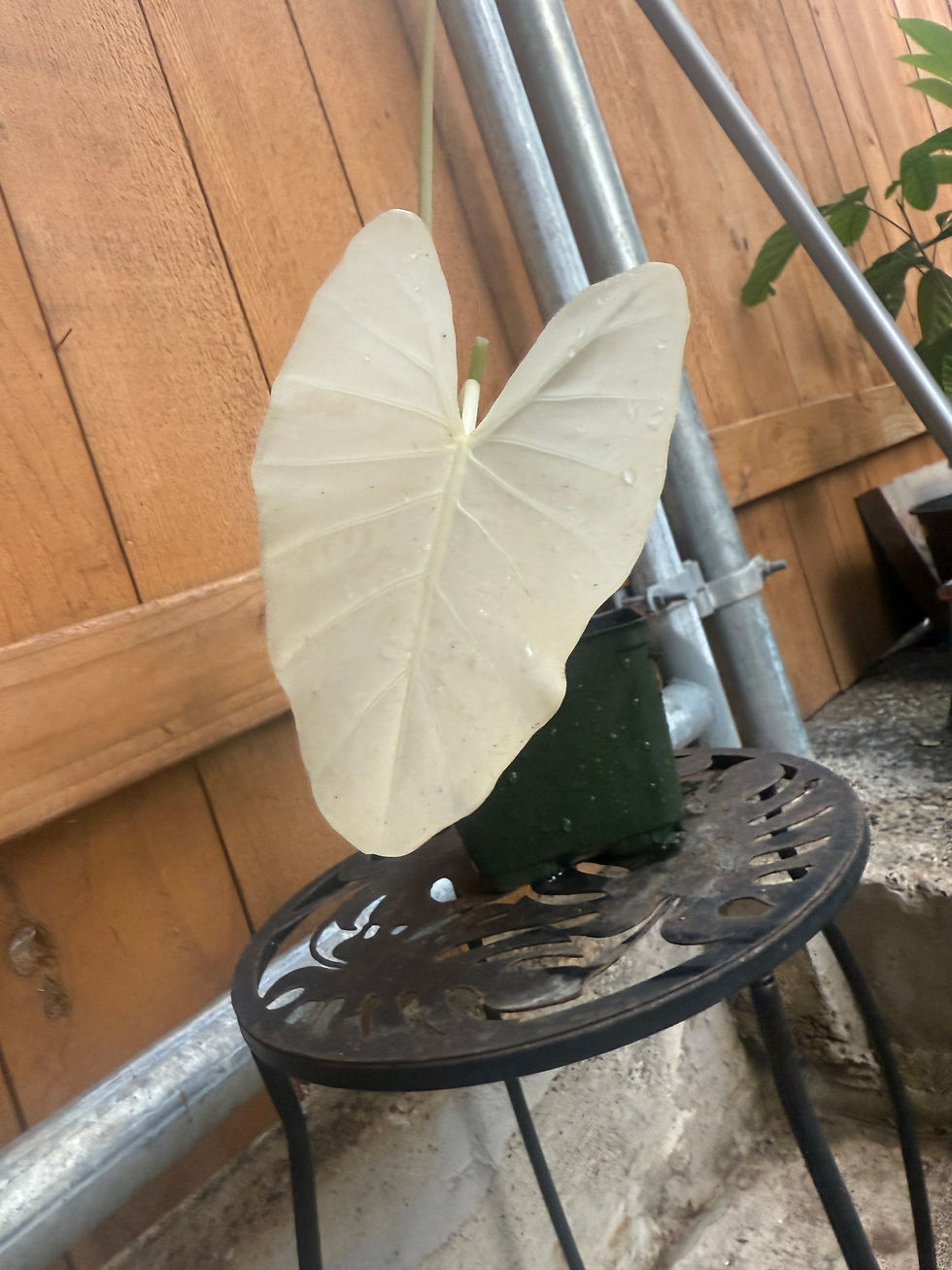


Philodendron Florida Beauty Variegated
Light: Bright indirect, 1,000 to 2,000 foot-candles. The variegated form needs noticeably more than a plain green Philodendron. No harsh midday sun.
Water: When the top 2 inches dry. Water through, drain fully. More forgiving of a missed watering than of a wet pot.
Support: Give it a moss pole or plank. It is a climber, and leaves stay small and poorly lobed without one.
Keeping the variegation
The cream and yellow comes from a chimera — two genetically different cell lines growing side by side in the same plant. It is not stable, and the plant does not owe you a balanced leaf.
Two things go wrong, in opposite directions:
Reversion. The vine starts throwing solid green leaves. Usually a light problem. Green tissue is more efficient, so in dim conditions the green line outcompetes the variegated one.
All-white leaves. Pretty, and a dead end. White tissue has no chlorophyll and cannot feed itself. A shoot that goes fully white will weaken and eventually die back.
Manage both the same way: cut back to a node below the problem where the leaf shows a healthy mix of green and cream, and let it push a new vine from there. Make the cut just above that node. Half green, half variegated is the target — that is the growing point most likely to keep producing both.
More light reduces reversion up to a point. If leaves are green and the plant sits more than a few feet from a window, move it closer before you start cutting.
The same rule governs propagation. A cutting carries whatever the node above it carries, so take stem cuttings with at least one node and a leaf that shows both colors. An all-white cutting will root and then decline.
